An F1 car weighs 800 kg. A Porsche 911 weighs 1,450 kg. An F1 car brakes from 300 km/h in 3.5 seconds. The real differences, with actual numbers.
At first glance, a Formula 1 car and a road car are both four-wheeled vehicles with an engine, tyres, and a steering wheel. But the similarities end there. An F1 car is a purpose-built racing machine that shares almost no technology, materials, or design philosophy with a road car. This guide compares the two side by side — with real numbers — to show exactly how different they are, and why those differences matter.
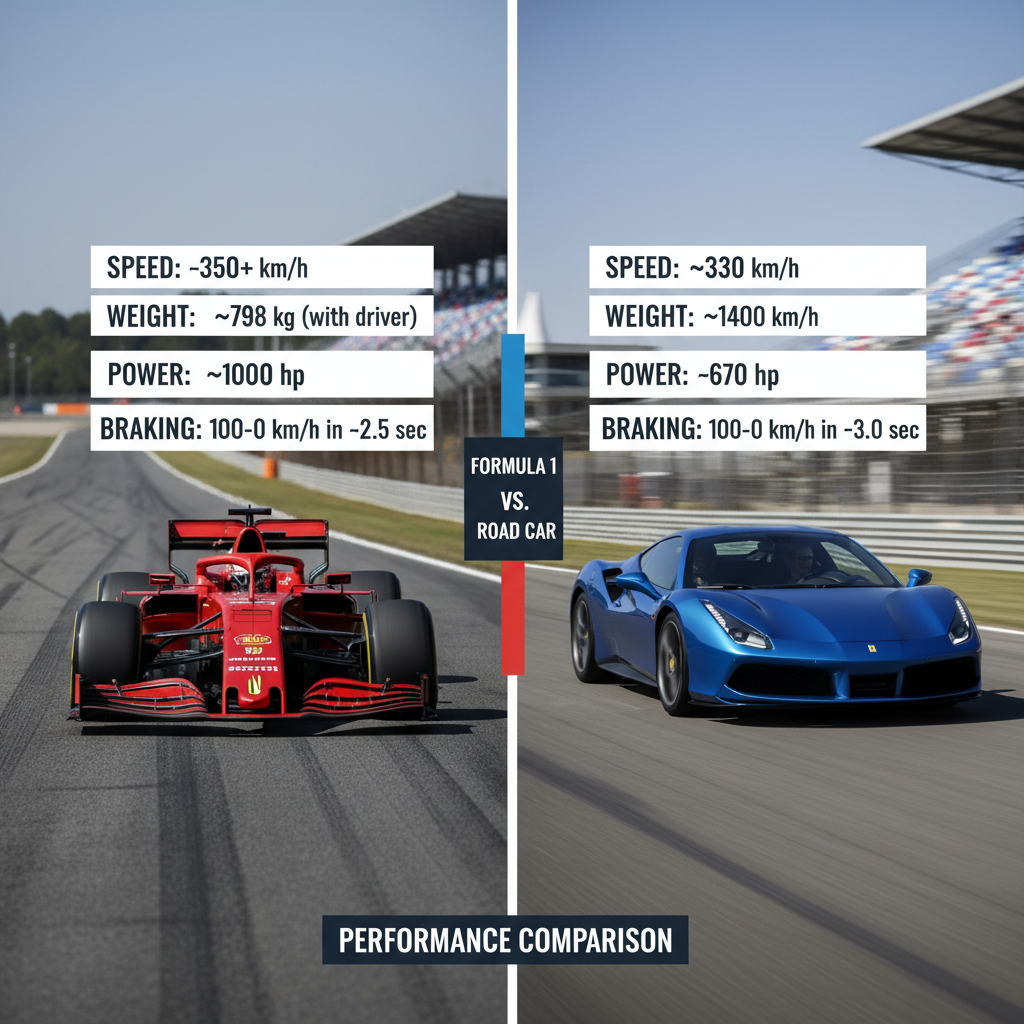
The Numbers: F1 Car vs Road Car Side by Side
| Specification | F1 Car (2025) | Porsche 911 GT3 | BMW M3 Competition | Toyota Corolla |
|---|---|---|---|---|
| Weight (kerb) | 800 kg (min, with driver) | 1,418 kg | 1,730 kg | 1,390 kg |
| Power output | 1,000+ HP | 510 HP | 503 HP | 168 HP |
| Power-to-weight | 1,250 HP/tonne | 360 HP/tonne | 291 HP/tonne | 121 HP/tonne |
| 0–100 km/h | ~2.5 sec | 3.4 sec | 3.9 sec | ~9 sec |
| Top speed | ~370 km/h | 318 km/h | 290 km/h | 180 km/h |
| Braking (300–0) | ~3.5 sec / 65m | ~5 sec / 100m | N/A | N/A |
| Fuel capacity | 110 kg | 64 litres | 59 litres | 50 litres |
| Tyre width (rear) | ~305 mm | 305 mm | 275 mm | 205 mm |
| Downforce at 200 km/h | ~1,500 kg | Minimal | Minimal | None |
| Price | $25–30M (build cost) | $230,000 | $85,000 | $25,000 |
Weight: Why F1 Cars Are So Light
The minimum weight of a Formula 1 car (including the driver) is 800 kg. A typical family car weighs 1,200–1,500 kg. A high-performance sports car like a Porsche 911 GT3 weighs 1,418 kg. The F1 car is lighter despite being a complete racing machine with a complex hybrid power unit, because it is built from carbon fibre composite rather than steel and aluminium.
Carbon fibre composite is approximately five times stronger than steel by weight. The carbon fibre monocoque — the structural core of the car — weighs just 35–40 kg. The entire car without the power unit weighs approximately 500 kg. The power unit adds approximately 150 kg. The driver adds approximately 70–80 kg (with helmet and HANS device). The fuel at the start of the race adds up to 110 kg. Together, these reach the 800 kg minimum.
The low weight is critical for performance. Newton's second law (F=ma) tells us that for a given force, a lighter object accelerates faster. An F1 car's extraordinary acceleration, braking, and cornering performance is partly a function of its low weight. If an F1 car weighed as much as a Porsche 911 GT3, its performance would be dramatically reduced despite having twice the power.
The Engine: Completely Different Technology
The engine in a road car and the power unit in an F1 car are fundamentally different technologies. A typical road car engine is a naturally aspirated or mildly turbocharged unit producing 100–500 HP, designed to last 200,000+ km with minimal maintenance, run on pump petrol, and operate reliably in temperatures from -20°C to +40°C. An F1 power unit produces 1,000+ HP, is designed to last approximately 7 race weekends (roughly 2,000 km), runs on specially formulated fuel, and operates within a narrow temperature window.
The F1 power unit's thermal efficiency exceeds 50% — the highest ever achieved by an internal combustion engine. A typical road car engine achieves 35–40%. This extraordinary efficiency is achieved through: extremely high compression ratios, direct fuel injection at very high pressure, advanced combustion chamber design, and the energy recovery systems that capture energy that would otherwise be wasted as heat.
Aerodynamics: Downforce vs Drag
Road cars are designed to minimise aerodynamic drag — the resistance that slows the car and reduces fuel efficiency. Most road cars generate slight lift at high speed (which is why high-performance road cars have spoilers to counteract this). F1 cars are designed to generate maximum aerodynamic downforce — a downward force that pushes the car into the track, increasing grip and allowing higher cornering speeds.
At 200 km/h, a modern F1 car generates approximately 1,500 kg of downforce — nearly twice the car's own weight. This means the tyres are being pushed into the track with a force of approximately 2,300 kg (800 kg car weight + 1,500 kg downforce). This enormous grip allows the car to corner at lateral G-forces of 4–6G. A road car at the same speed generates minimal downforce and corners at approximately 1G.
Brakes: Carbon vs Cast Iron
F1 cars use carbon-carbon disc brakes — made from carbon fibre composite rather than the cast iron used in road cars. Carbon brakes are significantly lighter (approximately 1 kg per disc vs 5–8 kg for cast iron) and can withstand much higher temperatures (up to 1,000°C vs approximately 600°C for cast iron). However, they only work effectively above a minimum operating temperature of approximately 400°C — which is why F1 drivers sometimes brake unusually late on the first lap to warm them up.
The braking performance difference is dramatic. An F1 car can brake from 300 km/h to a complete stop in approximately 3.5 seconds, covering 65 metres. A Porsche 911 GT3 — one of the best-braking road cars available — takes approximately 5 seconds and 100 metres to stop from 300 km/h. The F1 car's braking advantage comes from its carbon brakes, its aerodynamic drag (the wings act as air brakes), and its low weight.
Safety: Designed for Crashes vs Designed to Avoid Them
Road cars are designed with safety systems that protect occupants in the event of a crash: crumple zones, airbags, seatbelts, and reinforced passenger cells. F1 cars take a different approach: they are designed to withstand crashes that would destroy a road car, while protecting the driver in a survival cell that remains intact even in the most severe impacts.
The F1 monocoque survival cell must pass 18 FIA crash tests before the car can race. The Halo device protects the driver's head from debris and in rollover situations. The HANS device prevents the driver's head from moving forward in a frontal impact. The FIA-specification helmet is rated to withstand 800°C for 12 seconds. The fireproof race suit provides similar protection. The result is that drivers regularly walk away from crashes that would be fatal in a road car.
Can You Drive an F1 Car on the Road?
No. An F1 car cannot legally be driven on public roads in any country. It has no headlights, no indicators, no windscreen wipers, no number plates, and no road-legal tyres. It also has no reverse gear (until recently — some modern F1 cars have a limited reverse function for pit lane use). The driving position is extremely reclined, with the driver's legs extended in front of them, making normal road visibility impossible. The car requires a warm-up procedure before it can be driven, and the tyres must reach operating temperature before they provide adequate grip.
Related Reading