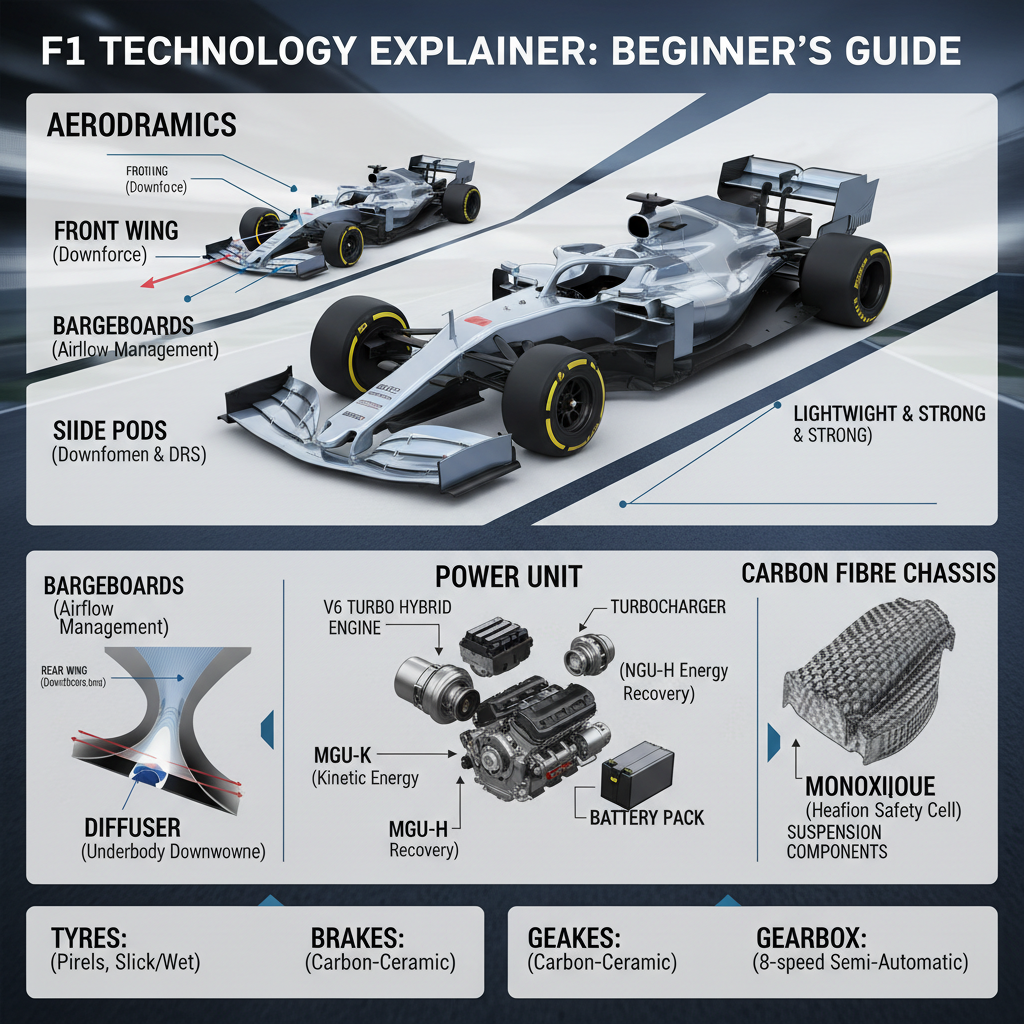
Everything you need to know about what makes an F1 car different from any other racing machine — power unit, aerodynamics, chassis, and more.
A Formula 1 car is the most technologically advanced racing machine ever built. It is a purpose-designed, single-seat, open-wheel racing car constructed entirely from scratch each season by one of ten competing constructor teams. Every component — from the carbon fibre monocoque chassis to the 1.6-litre turbocharged hybrid power unit — is engineered to extract maximum performance within a strict set of regulations written by the Fédération Internationale de l'Automobile (FIA). If you've ever watched an F1 race and wondered what exactly you're looking at, this guide will explain everything from the ground up.
The Definition: What Makes a Car a Formula 1 Car?
Formula 1 is the highest class of single-seater open-wheel motor racing in the world. The "Formula" in the name refers to the set of rules — the formula — that all competing cars must conform to. These rules are written annually by the FIA and cover every aspect of the car: its dimensions, weight, engine specification, aerodynamic surfaces, safety structures, electronics, and materials.
An F1 car is not a modified road car, nor is it a prototype endurance racer. It is a bespoke racing machine built for one purpose: to complete a race circuit as fast as possible. The cars are rebuilt from scratch each season, with teams investing hundreds of millions of dollars in design, development, and manufacturing. In the 2025 season, the minimum car weight (including the driver) is 800 kg, the power unit produces over 1,000 horsepower, and the car can reach a top speed of approximately 370 km/h.
The Six Core Components of a Formula 1 Car
Every Formula 1 car is built around six fundamental systems. Understanding each one gives you a complete picture of what makes these machines so extraordinary.
1. The Power Unit
The power unit is the heart of the car. Since 2014, all F1 cars have used a 1.6-litre V6 turbocharged internal combustion engine paired with two motor generator units: the MGU-K (Motor Generator Unit – Kinetic) and the MGU-H (Motor Generator Unit – Heat). Together, these systems produce over 1,000 horsepower — roughly three times the output of a typical high-performance road car. The thermal efficiency of the F1 power unit exceeds 50%, making it the most thermally efficient internal combustion engine ever produced for any application. For comparison, the average road car engine achieves 35–40% thermal efficiency. The MGU-K recovers kinetic energy under braking and deploys it as additional electric power. The MGU-H (which is being eliminated from 2026) recovers heat energy from the turbocharger exhaust gases. In 2026, the power split will shift to near 50/50 between the internal combustion engine and the electric motor, and 100% sustainable fuel will be mandated.
2. The Chassis
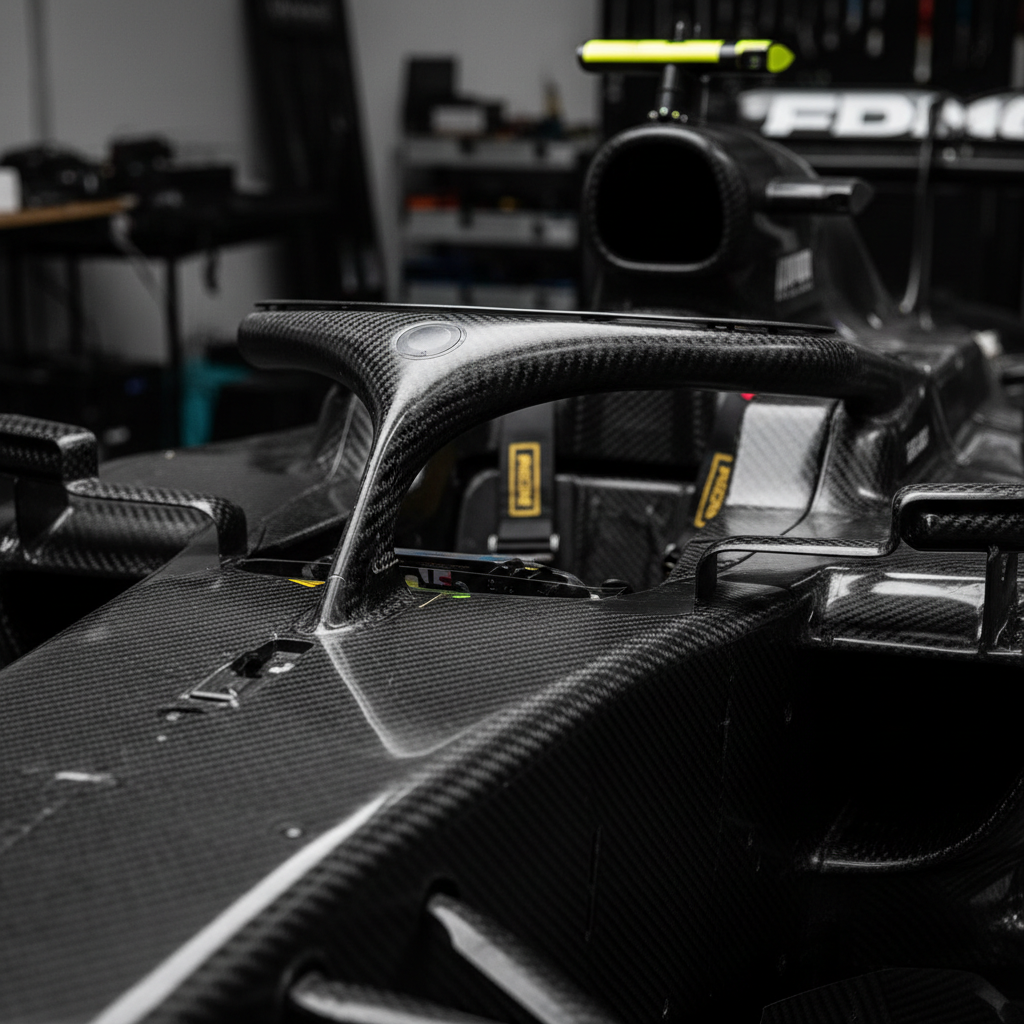
The chassis is the structural backbone of the car. In modern F1, the chassis is a carbon fibre monocoque — a single-piece shell that forms both the structure and the survival cell for the driver. The monocoque alone weighs just 35–40 kg, yet it is strong enough to withstand crash impacts of 52G. Before any car can race, the FIA requires it to pass 18 separate crash tests, including frontal, side, and rear impact tests. The Halo device — a titanium bar mounted above the cockpit — was made mandatory in 2018 and is rated to withstand the weight of a double-decker bus. It has saved multiple drivers' lives since its introduction.
3. Aerodynamics
Aerodynamics is arguably the most important performance differentiator between F1 cars. Unlike road cars, which are designed to minimise drag, F1 cars are designed to generate enormous downforce — a downward aerodynamic force that pushes the car into the track, allowing it to corner at speeds that would be physically impossible otherwise. The primary sources of downforce are the front wing, the rear wing, and the floor of the car. Since 2022, the floor uses venturi tunnels — shaped channels that accelerate airflow underneath the car, creating a low-pressure zone that literally sucks the car to the tarmac. This is called ground effect, and it generates 60–65% of the car's total downforce. At high speed, an F1 car generates enough downforce to theoretically drive upside down on a ceiling.
4. Tyres
Pirelli has been the sole tyre supplier to Formula 1 since 2011. In 2025, six dry-weather compounds are available, ranging from C1 (the hardest, most durable) to C6 (the softest, fastest but quickest to degrade). The correct tyre choice and management strategy is one of the most critical factors in race performance. F1 tyres must reach an optimal operating temperature window of 80–120°C to deliver maximum grip. Below this window, they are cold and slippery; above it, they degrade rapidly. The forces acting on F1 tyres in high-speed corners can exceed six times the weight of the car. Since 2022, F1 has used 18-inch low-profile tyres, replacing the previous 13-inch high-profile design.
5. Electronics and Data Systems
A modern F1 car carries between 150 and 300 sensors that monitor every conceivable parameter: tyre temperature, brake temperature, fuel flow rate, suspension travel, G-forces, engine vitals, GPS positioning, and much more. This data is transmitted to the team's pitwall in real time at a rate of approximately 1.1 million data points per second. The FIA mandates a standard Electronic Control Unit (ECU) in all cars to prevent teams from gaining unfair electronic advantages. Drivers must manage over 20 different systems during a single race lap — adjusting brake bias, energy deployment, differential settings, and tyre management modes — all while driving at the limit.
6. Safety Systems
Modern F1 cars are extraordinarily safe by historical standards. The safety systems include: the carbon fibre monocoque survival cell, the Halo cockpit protection device (mandatory since 2018), the HANS (Head and Neck Support) device worn by the driver, FIA-specification helmets rated to withstand 800°C for 12 seconds, fireproof race suits, and SAFER (Steel and Foam Energy Reduction) barriers at all circuits. The medical car is present at every race, and a circuit-based medical team is on standby throughout every session.
Who Builds Formula 1 Cars?
Ten constructor teams compete in the 2025 Formula 1 World Championship. Each team designs and builds its own chassis, but may use a power unit supplied by one of the four engine manufacturers: Mercedes, Ferrari, Renault (Alpine), and Honda (Red Bull Powertrains). The ten teams are: Ferrari, McLaren, Mercedes, Red Bull Racing, Aston Martin, Alpine, Williams, Haas, Racing Bulls (formerly AlphaTauri), and Kick Sauber (formerly Alfa Romeo). From 2026, Audi will join as a manufacturer, and Cadillac will enter as the eleventh team.
Building an F1 car requires a workforce of hundreds of engineers, designers, aerodynamicists, mechanics, and data analysts. A front-running team like Ferrari or Mercedes employs over 1,000 people dedicated to car design and development. The annual budget for a top team — including all items outside the FIA cost cap — is estimated at over $300 million.
How Are Formula 1 Cars Regulated?
The FIA publishes detailed technical regulations each year that define exactly what an F1 car can and cannot be. These regulations cover: minimum weight (800 kg including driver in 2025), maximum fuel load (110 kg per race), engine specification (1.6L V6 turbo hybrid), aerodynamic surface dimensions and positions, mandatory safety structures, tyre specifications, and electronics standards. Teams employ entire departments dedicated to interpreting and exploiting these regulations — finding performance within the rules is as important as raw engineering capability.
Formula 1 Car Quick Stats (2025)
| Specification | Formula 1 Car (2025) | Typical Sports Car |
|---|---|---|
| Weight (with driver) | 800 kg (minimum) | 1,400–1,600 kg |
| Power output | 1,000+ HP combined | 300–600 HP |
| Top speed | ~370 km/h | ~300 km/h |
| 0–100 km/h | ~2.5 seconds | 3.5–5 seconds |
| Braking (300–0 km/h) | ~3.5 seconds | ~7–8 seconds |
| Fuel capacity | 110 kg maximum | 50–80 litres |
| Downforce at 200 km/h | ~1,500 kg | Minimal or negative |
| Data sensors | 150–300 | 10–20 |
What Makes an F1 Car Different from Any Other Racing Car?
Formula 1 cars are distinguished from other racing categories by several key characteristics. First, they are open-wheel — the wheels are exposed outside the bodywork, which creates unique aerodynamic challenges and opportunities. Second, they are single-seater — designed for one driver only. Third, they are constructor-built — each team designs and builds its own car, rather than racing a manufacturer-supplied spec vehicle. Fourth, they operate at the absolute frontier of automotive technology — innovations developed for F1 regularly filter down to road cars, including carbon fibre construction, semi-automatic gearboxes, and energy recovery systems.
Compared to other top-level racing categories: a Le Mans LMP1 prototype is heavier and optimised for endurance rather than peak lap time; a NASCAR stock car is far heavier, less aerodynamically sophisticated, and uses a pushrod V8 engine; an IndyCar is similar in concept but uses a spec chassis and a less complex power unit. F1 is unique in combining the highest level of constructor freedom with the most sophisticated technology in motorsport.
The Evolution of the Formula 1 Car
The first Formula 1 World Championship race took place on 13 May 1950 at Silverstone, UK, and was won by Giuseppe Farina driving an Alfa Romeo 158. That car had a supercharged 1.5-litre straight-eight engine, wire-spoke wheels, and no aerodynamic devices whatsoever. In 75 years, the Formula 1 car has evolved through nine distinct technical eras: the front-engine era of the 1950s, the rear-engine revolution of the 1960s, the wing era and 3-litre formula of the late 1960s and 1970s, the ground effect and turbo wars of the late 1970s and 1980s, the V10 golden age of the 1990s and early 2000s, the V8 cost-control era, the hybrid power revolution from 2014, the return of ground effect from 2022, and the active aero era beginning in 2026.
Related Reading