McLaren MP4/4 won 15 of 16 races. Ferrari F2004 dominated 2004. Red Bull RB9 swept 2013. Ranking the machines that defined their eras.
What makes a Formula 1 car truly great? Dominance is the obvious measure — winning races, championships, and setting records. But the greatest F1 cars are also those that changed the sport, introduced technologies that became universal standards, or achieved performances so extraordinary that they remain benchmarks decades later. This ranking considers all three criteria: on-track results, technical innovation, and historical significance.
1. McLaren MP4/4 (1988) — The Most Dominant F1 Car Ever Built
The McLaren MP4/4 is the most statistically dominant Formula 1 car in the history of the sport. In the 1988 season, it won 15 of the 16 races on the calendar — the only race it failed to win was the Italian Grand Prix at Monza, where both cars retired while leading. Ayrton Senna and Alain Prost drove the MP4/4 to a combined 15 wins, 15 pole positions, and 10 fastest laps. Senna won the Drivers' Championship; McLaren won the Constructors' Championship by a margin that has never been equalled.
The MP4/4 was powered by a Honda RA168E 1.5-litre turbocharged V6 engine producing approximately 685 HP in race trim and over 900 HP in qualifying specification. The chassis, designed by Gordon Murray and Steve Nichols, was a masterpiece of low-drag aerodynamics. The car's dominance was so complete that it prompted the FIA to ban turbocharged engines from 1989 — a direct response to the MP4/4's performance.
2. Ferrari F2004 — The Greatest Naturally Aspirated F1 Car
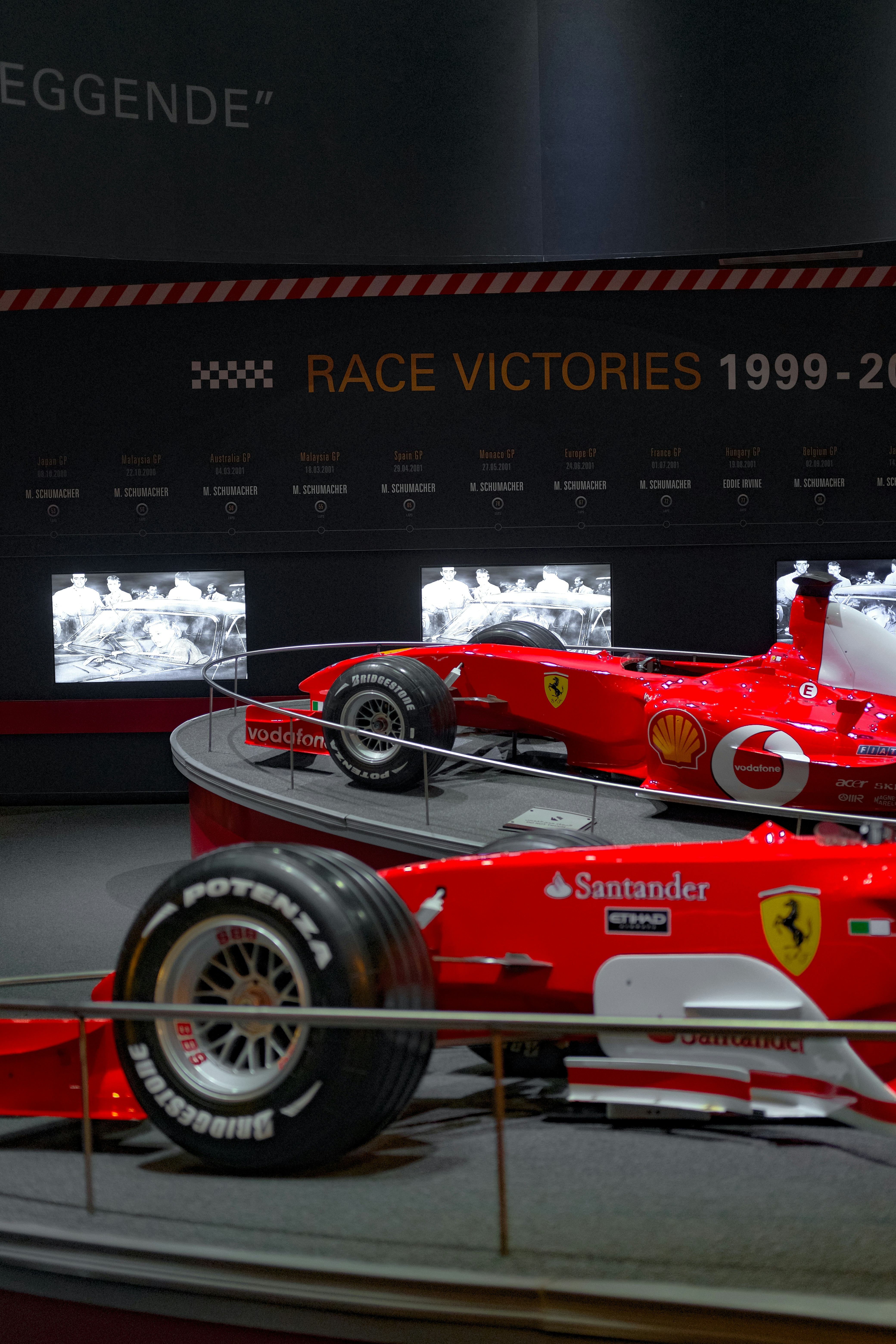
The Ferrari F2004 is widely considered the greatest naturally aspirated Formula 1 car ever built. In the 2004 season, Michael Schumacher and Rubens Barrichello drove the F2004 to 15 wins from 18 races. Schumacher won his seventh and final World Drivers' Championship, and Ferrari won the Constructors' Championship with 262 points — a record at the time. The F2004 was powered by a Ferrari Tipo 053 3.0-litre V10 engine producing approximately 900 HP at 19,000 RPM.
What made the F2004 exceptional was not just its pace but its reliability and consistency. It was the culmination of a decade of Ferrari development under technical director Ross Brawn and chief designer Rory Byrne. The car was fast, reliable, and perfectly suited to Schumacher's driving style. Its 2004 season record of 15 wins from 18 races remains one of the most dominant single-season performances in F1 history.
3. Red Bull RB9 (2013) — The Last of the V8 Dominators
The Red Bull RB9 completed one of the most dominant periods in modern F1 history. Sebastian Vettel won 13 consecutive races in the second half of the 2013 season — a record that still stands — and claimed his fourth consecutive World Drivers' Championship. Red Bull won the Constructors' Championship with 596 points, nearly double the second-placed Mercedes. The RB9 was designed by Adrian Newey, widely regarded as the greatest F1 car designer in history, and featured extraordinarily sophisticated aerodynamics that maximised the performance of the 2.4-litre V8 engine.
4. Williams FW14B (1992) — The Most Technologically Advanced Car of Its Era
The Williams FW14B was the most technologically sophisticated Formula 1 car of its time. It featured active suspension (which automatically adjusted the car's ride height and attitude in real time), traction control, anti-lock brakes, and a semi-automatic gearbox. Nigel Mansell drove it to 9 wins from 16 races and the 1992 World Drivers' Championship, winning by a record margin of 52 points. The FW14B was so dominant that the FIA subsequently banned active suspension, traction control, and ABS from 1994.
5. Mercedes W11 (2020) — The Greatest Hybrid Era Car
The Mercedes W11 is the most dominant car of the hybrid era. Lewis Hamilton drove it to 11 wins from 17 races in the COVID-shortened 2020 season, claiming his seventh World Drivers' Championship — equalling Michael Schumacher's record. Mercedes won the Constructors' Championship with 573 points. The W11 featured a revolutionary "Dual Axis Steering" (DAS) system that allowed the driver to adjust front wheel toe angle from the cockpit — a system that was immediately banned for 2021.
6. Lotus 79 (1978) — The Car That Invented Ground Effect
The Lotus 79 is one of the most historically significant Formula 1 cars ever built. Designed by Colin Chapman and Peter Wright, it was the first car to fully exploit ground effect aerodynamics — using shaped sidepod tunnels to create a low-pressure zone under the car that generated enormous downforce without the drag penalty of large wings. Mario Andretti drove it to the 1978 World Drivers' Championship. The ground effect concept introduced by the Lotus 79 has influenced every F1 car designed since, and was formally reintroduced as the primary aerodynamic concept in the 2022 regulations.
7. McLaren MCL39 (2025) — The Modern Champion
The McLaren MCL39 is the most successful car of the current ground effect era. Lando Norris drove it to the 2025 World Drivers' Championship — his first title — while McLaren claimed their second consecutive Constructors' Championship. The MCL39 was the culmination of a multi-year development programme that transformed McLaren from a midfield team in 2020 to the dominant force in F1 by 2024–2025. Its aerodynamic efficiency and tyre management characteristics were considered the best on the grid.
8. Brawn BGP 001 (2009) — The Greatest Underdog Story in F1
The Brawn BGP 001 is the greatest underdog story in Formula 1 history. When Honda withdrew from F1 at the end of 2008, the team was purchased by its employees — led by Ross Brawn — for a nominal sum. The car they had been developing, the BGP 001, featured a revolutionary double diffuser that generated significantly more downforce than rival cars. Jenson Button won 6 of the first 7 races of the 2009 season and claimed the World Drivers' Championship. Brawn GP won the Constructors' Championship in their only season of existence before being sold to Mercedes.
9. Red Bull RB6 (2010) — The Start of an Era
The Red Bull RB6 launched the most dominant period in F1 since the Schumacher-Ferrari era. Sebastian Vettel won his first World Drivers' Championship in 2010 in one of the most dramatic season finales in F1 history, overtaking three rivals in the final race at Abu Dhabi. The RB6 was the first of four consecutive championship-winning Red Bull cars, all designed by Adrian Newey, and established the aerodynamic philosophy that would define the sport for the next four years.
10. Ferrari 500 (1952–1953) — The Pioneer
The Ferrari 500 was the dominant car of the early World Championship era. Alberto Ascari drove it to back-to-back World Drivers' Championships in 1952 and 1953, winning 11 consecutive races — a record that stood for 50 years until Vettel's 2013 streak. The Ferrari 500 was powered by a 2.0-litre four-cylinder engine producing approximately 185 HP — modest by modern standards, but extraordinary for its era. It represents the foundation of Ferrari's unmatched F1 legacy.
Related Reading