Introduced in 2021 at $145M. Red Bull breached it by $2.6M and were fined $7M. How the spending limit reshaped F1 competition — and what it still misses.
For the first 70 years of Formula 1, there was no limit on how much a team could spend. The richest teams — Ferrari, Mercedes, Red Bull — spent hundreds of millions of dollars each year developing their cars, while smaller teams struggled to survive on a fraction of that budget. The result was a sport where financial resources were as important as engineering talent, and where the gap between the richest and poorest teams was enormous. In 2021, the FIA introduced the Financial Regulations — commonly known as the cost cap — in an attempt to level the playing field. This is the story of how that decision changed Formula 1.
The Pre-Cost-Cap Era: How Much Did Teams Really Spend?
Before 2021, Formula 1 teams were not required to disclose their budgets, and estimates varied widely. However, based on public financial filings, industry analysis, and team statements, the following estimates are widely cited for the 2019 season (the last full season before COVID-19):
| Team | Estimated 2019 Budget | Notes |
|---|---|---|
| Mercedes | ~$484M | Highest estimated spend; includes engine development |
| Ferrari | ~$463M | Includes Maranello factory operations |
| Red Bull | ~$445M | Includes Red Bull Technology campus |
| McLaren | ~$215M | Recovering from difficult period |
| Renault | ~$272M | Works team with engine development |
| Racing Point | ~$149M | Midfield team |
| Williams | ~$132M | Struggling financially |
| Haas | ~$130M | Smallest budget on grid |
These figures are estimates from public sources and independent analysts. Teams did not disclose exact budgets. The gap between the top teams and the bottom teams was approximately $350 million — meaning Mercedes spent roughly 3.7 times more than Haas. This financial disparity was widely seen as one of the biggest structural problems in F1.
Why Was the Cost Cap Introduced?
The FIA and Formula 1 Management (FOM) had been discussing a cost cap for years before it was finally implemented. The primary motivations were: competitive balance (reducing the performance gap between rich and poor teams), financial sustainability (preventing smaller teams from going bankrupt), and long-term health of the sport (making F1 attractive to new manufacturers and investors).
The COVID-19 pandemic accelerated the timeline. When the 2020 season was delayed and shortened, several teams faced severe financial difficulties. The cost cap was brought forward and the initial limit was reduced from the originally planned $175 million to $145 million to reflect the reduced revenue environment. All ten teams agreed to the Financial Regulations, which came into force for the 2021 season.
What Does the Cost Cap Cover — and What Doesn't It Cover?
The cost cap is more nuanced than a simple spending limit. It covers a specific set of "Relevant Costs" and excludes others. Understanding what is and isn't covered is essential to understanding the cap's real impact.
| Included in Cap | Excluded from Cap |
|---|---|
| Car design and development | Driver salaries |
| Component manufacturing | Top 3 highest-paid staff wages |
| Aerodynamic development (wind tunnel, CFD) | Engine development (separate cap) |
| Race operations | Marketing and commercial activities |
| Simulator operations | Travel costs above base allowance |
| Most staff wages | Hospitality and entertainment |
| Testing | Legal and regulatory costs |
The exclusion of driver salaries is particularly significant. Top drivers like Lewis Hamilton and Max Verstappen earn estimated salaries of $40–60 million per year — amounts that would consume a large portion of the cap if included. The exclusion of the top three staff wages also means that the highest-paid engineers and technical directors are not counted, which critics argue allows rich teams to retain talent advantages.
The Red Bull Breach: A Defining Moment for the Cost Cap
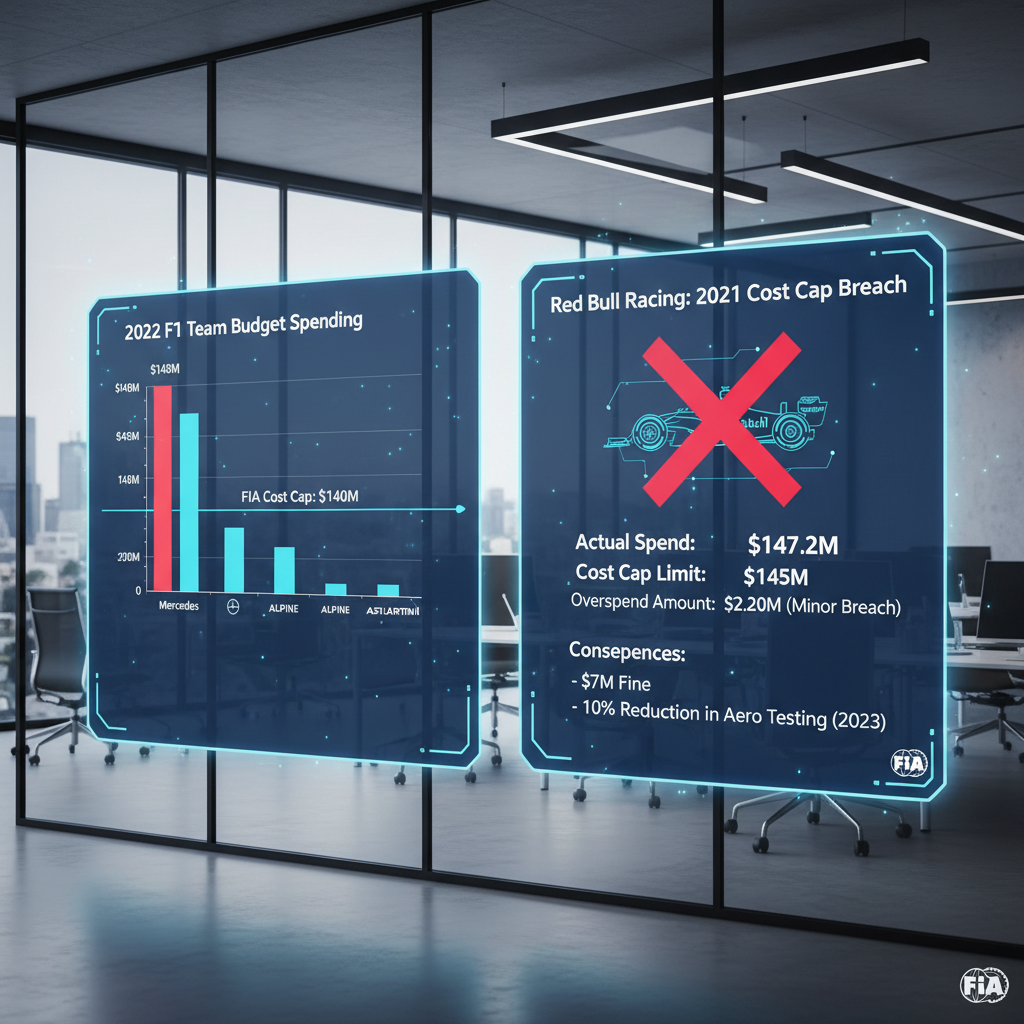
In October 2022, the FIA confirmed that Red Bull Racing had breached the 2021 cost cap by $2.6 million — approximately 1.8% over the $145 million limit. This was classified as a "minor" breach (under 5% overspend). The penalty imposed was a $7 million fine and a 10% reduction in aerodynamic testing (wind tunnel and CFD) time for 12 months.
The breach sparked significant controversy. Rival teams — particularly Mercedes and Ferrari — argued that even a small overspend provides a meaningful performance advantage. The FIA's own analysis suggested that $2.6 million of additional spending could translate to approximately 0.3–0.5 seconds per lap in performance terms. Red Bull accepted the penalty without appeal, but the controversy highlighted the need for stronger enforcement mechanisms.
The FIA subsequently strengthened its monitoring and enforcement procedures, including more frequent audits, improved financial reporting requirements, and clearer definitions of what constitutes a "Relevant Cost." All ten teams were confirmed to be within the 2022, 2023, and 2024 cost cap limits.
Has the Cost Cap Improved Competition?
The evidence on whether the cost cap has improved competition is mixed. On one hand, the 2022–2025 period has seen more constructor diversity at the front of the grid than the 2014–2021 Mercedes-dominated era. McLaren's rise from midfield to championship contender is partly attributed to the cost cap levelling the development playing field. Smaller teams like Haas and Williams have been able to remain competitive without facing existential financial pressure.
On the other hand, the top teams have found ways to maximise their advantage within the cap. Rich teams can spend more on excluded items (driver salaries, top staff wages, marketing) and can front-load development spending before the cap year begins. The performance gap between the top four teams and the rest of the grid remains significant.
The 2026 Cost Cap: A New Era of Financial Regulation
The 2026 regulations bring significant changes to the cost cap. The overall cap rises to $215 million — a substantial increase from the $140.4 million 2025 figure. This increase reflects the additional costs associated with the new power unit regulations, which require teams to develop entirely new hybrid systems. The engine development cap rises from $95 million to $130 million. New manufacturers Audi and Ford (with Red Bull Powertrains) will be subject to the same financial regulations as existing teams from their first season.
Related Reading