Ground effect floors, 350 kW electric motors, and carbon fibre that survives 52G crashes. The technology inside every F1 car, explained simply.
Formula 1 cars are the most technologically advanced racing machines on Earth. They combine aerospace-grade materials, cutting-edge aerodynamics, hybrid power systems, and real-time data analytics into a package that weighs just 800 kg and produces over 1,000 horsepower. If you've ever wondered what all the technical jargon actually means — ground effect, MGU-K, venturi tunnels, thermal efficiency — this guide explains it all in plain English.
The Power Unit: More Than Just an Engine
The term "power unit" is used in F1 rather than "engine" because the propulsion system is far more complex than a conventional engine. The F1 power unit consists of six components: the Internal Combustion Engine (ICE), the Motor Generator Unit – Kinetic (MGU-K), the Motor Generator Unit – Heat (MGU-H, until 2025), the Energy Store (ES, the battery), the Turbocharger (TC), and the Control Electronics (CE).
The ICE is a 1.6-litre V6 turbocharged engine running at up to 15,000 RPM. It produces approximately 550–600 HP on its own. The MGU-K is an electric motor connected to the crankshaft that can recover up to 120 kW (161 HP) of kinetic energy under braking and deploy up to 120 kW of additional power during acceleration. The MGU-H recovers heat energy from the turbocharger exhaust gases and uses it to either power the MGU-K or spin the turbocharger faster to eliminate turbo lag. Together, the complete power unit produces over 1,000 HP.
The thermal efficiency of the F1 power unit — the percentage of fuel energy converted into useful work — exceeds 50%. This is the highest thermal efficiency ever achieved by an internal combustion engine in any application. For comparison, a typical road car engine achieves 35–40% thermal efficiency, and a diesel truck engine achieves approximately 45%. The F1 power unit achieves this through a combination of extremely high compression ratios, direct fuel injection, advanced combustion chamber design, and the energy recovery systems that capture energy that would otherwise be wasted as heat.
Aerodynamics: How Downforce Works
Aerodynamics is the science of how air flows around and through the car. In F1, the primary aerodynamic goal is to generate downforce — a downward force that pushes the car into the track, increasing the grip available to the tyres and allowing the car to corner faster. The secondary goal is to minimise drag — the aerodynamic resistance that slows the car on straights.
Downforce is generated by wings and by the floor of the car. Wings work on the same principle as aircraft wings, but inverted — instead of generating lift (upward force), they generate downforce (downward force) by creating a pressure difference between the upper and lower surfaces. The front wing generates approximately 25–30% of the car's total downforce. The rear wing generates approximately 10–15%. The floor generates 60–65%.
Ground Effect: The Most Important Aerodynamic Concept in Modern F1
Ground effect is the aerodynamic phenomenon where the floor of the car generates downforce by accelerating airflow through shaped tunnels (called venturi tunnels) between the car and the track surface. As air is forced through the narrowing tunnel, it speeds up (by Bernoulli's principle), creating a low-pressure zone under the car. This low pressure literally sucks the car towards the track, generating enormous downforce without the drag penalty of large wings.
Ground effect was first exploited by the Lotus 78 and 79 in 1977–1978, banned in 1983 due to safety concerns, and reintroduced as the primary aerodynamic concept in the 2022 F1 regulations. The 2022+ cars generate approximately 60–65% of their downforce from the floor, compared to approximately 30–40% for the 2017–2021 cars. This makes the cars less sensitive to "dirty air" — the turbulent wake created by a car ahead — which was a key goal of the 2022 regulations to improve racing.
DRS: Drag Reduction System (2011–2025)
DRS (Drag Reduction System) was a movable rear wing element that drivers could open on designated straight sections of the circuit when within one second of the car ahead. Opening the DRS flap reduced rear wing drag by approximately 10–15%, adding approximately 10–15 km/h of top speed and making overtaking easier. DRS was introduced in 2011 and used until the end of the 2025 season. From 2026, it is replaced by Active Aero — a more sophisticated system where both front and rear wings automatically adjust their angle based on driving conditions.
The Chassis: Carbon Fibre and Crash Safety
The chassis of a Formula 1 car is a carbon fibre monocoque — a single-piece structural shell that forms both the body of the car and the survival cell for the driver. Carbon fibre composite is used because it offers an extraordinary combination of strength and lightness: the monocoque weighs just 35–40 kg, yet it is strong enough to withstand crash impacts of 52G.
Carbon fibre is made from thin strands of carbon atoms bonded together in a crystalline structure, woven into a fabric and impregnated with epoxy resin. The resulting composite material is approximately five times stronger than steel by weight. In F1, the carbon fibre is laid up by hand in multiple layers, with the fibre orientation carefully designed to provide maximum strength in the directions where loads are highest. The monocoque is then cured in an autoclave — a large pressure oven — at high temperature and pressure.
Before any F1 car can race, the FIA requires it to pass 18 separate crash tests. These include frontal impact tests (at 15 m/s), side impact tests, rear impact tests, and rollover tests. The Halo device — a titanium bar mounted above the cockpit — was made mandatory in 2018. It is rated to withstand a static load of 125 kN (approximately the weight of a double-decker bus) and has been credited with saving the lives of multiple drivers, including Romain Grosjean in his 2020 Bahrain fire crash and Charles Leclerc in the 2022 British Grand Prix.
Tyres: The Only Contact with the Track
The tyres are the only part of the car that contacts the track, making them arguably the most critical performance component. Pirelli has been the sole tyre supplier to Formula 1 since 2011. In 2025, six dry-weather compounds are available: C1 (hardest), C2, C3, C4, C5, and C6 (softest). For each race, Pirelli selects three of these compounds, and teams must use at least two different compounds during the race (unless the race is interrupted by a safety car or red flag).
F1 tyres are not inflated with air but with nitrogen, which provides more consistent pressure across the operating temperature range. The tyres must reach an optimal operating temperature of 80–120°C to deliver maximum grip. Below this window, the rubber is too hard and provides insufficient grip; above it, the rubber degrades rapidly. Tyre temperature management is one of the most complex aspects of F1 race strategy.
Data and Electronics: 1.1 Million Data Points Per Second
A modern Formula 1 car carries between 150 and 300 sensors that monitor every conceivable parameter. This data is transmitted to the team's pitwall in real time at approximately 1.1 million data points per second. The data includes: tyre temperature (inner, middle, and outer for each tyre), brake temperature, fuel flow rate, suspension travel (at each corner), G-forces (longitudinal, lateral, and vertical), engine vitals (oil temperature, water temperature, oil pressure), GPS positioning (accurate to centimetres), and much more.
The FIA mandates a standard Electronic Control Unit (ECU) in all cars — the McLaren Electronic Systems (MES) TAG-320 — to prevent teams from gaining unfair electronic advantages. The ECU controls the engine management, energy recovery systems, and data logging. Teams can customise the software running on the ECU within FIA-defined parameters, but cannot replace the hardware.
2026 Technology: What Changes Next
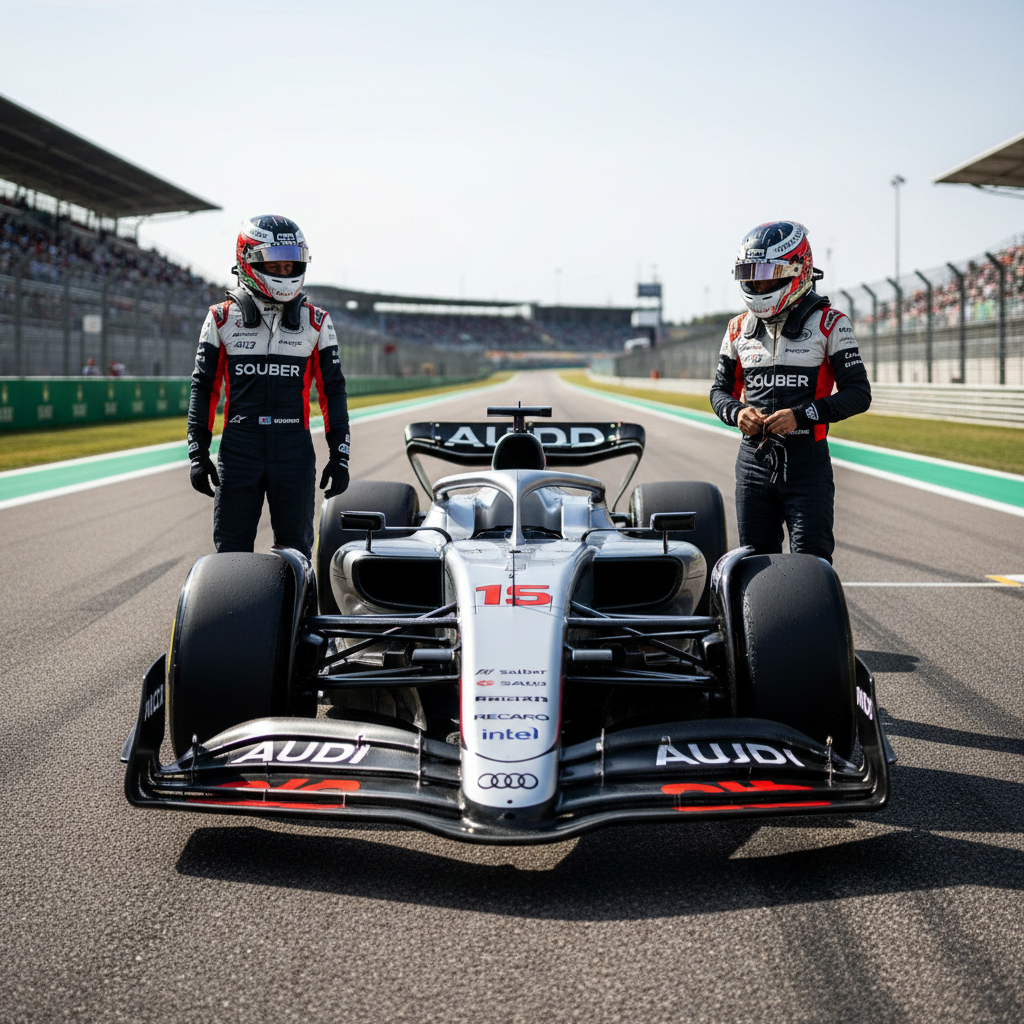
The 2026 F1 regulations introduce the most significant technical changes since the hybrid era began in 2014. The key changes are: the MGU-H is eliminated (simplifying the power unit and reducing costs); the power split shifts to near 50/50 between the ICE and the electric motor; 100% sustainable fuel is mandated; DRS is replaced by Active Aero (movable front and rear wings that automatically adjust); and the overall car dimensions are reduced to improve racing. New manufacturers Audi and Ford (with Red Bull Powertrains) join the grid, and Cadillac enters as the eleventh team.
Related Reading